ZoomMultistompZDL
Carillon
A resonant filter bank, after the one in the Torso S-4. 32 narrow band-pass filters from C2 to C8, each tuned to a note of the key and scale you pick. At low Decay they work together as one filter you shape with Cutoff, Reso and Slope. Turn Decay up and every band starts to ring on its own, until whatever you play sets off a bank of tuned bells.
MS-70CDR, Delay group, effect ID 421 (497 until version 0.04). File: dist/Carillon.ZDL.
Knobs
| Knob | Range | What it does |
|---|---|---|
| Cut (Cutoff) | 0–100 | Where the filter’s emphasis sits, from below C2 to above C8 |
| Reso | 0–100 | Boosts the bands around Cutoff, like a filter’s resonance |
| Decay | 0–100 | How narrow each band is and how long it rings. 0 one plain filter, 50 about a second of ring, 100 bells: a few seconds in the middle, longest in the low bands |
| Key | C … B | The scale’s root. In Free, moves the whole bank up in semitones |
| Scale | Free, Chrom, Major, Minor, Dor, Pent, MinPt, Whole, Fifth, Oct | The notes the bands snap to. Free leaves them evenly spaced. In Fifth and Oct several bands land on the same note, so fewer ring |
| Slope | 0–100 | 0 low-pass, 50 band-pass, 100 high-pass |
| Waves | 0–100 | A slow ripple across the bands. Up to 50: deeper. 50 and up: full depth, faster (about 0.1 to 2.5 Hz) |
| Noise | 0–100 | Up to 50: random bands are struck on their own, more often as you turn it up. 50 and up: up to 20 a second, and a quiet hiss that makes the bank whistle |
| Mix | 0–100 | Dry/wet |
The bank is mono going in (L and R mixed). Even bands lean left and odd ones right, so the ringing spreads across the stereo field.
The level is evened out as Decay narrows the bands (measured on DI guitar). Notes that land right on a band ring loudest: pure synth tones in the key come out louder at high Decay, and a limiter holds the peaks. Playing in the key and scale you set gives the most ring; notes between the bands pass through quietly.
Screen
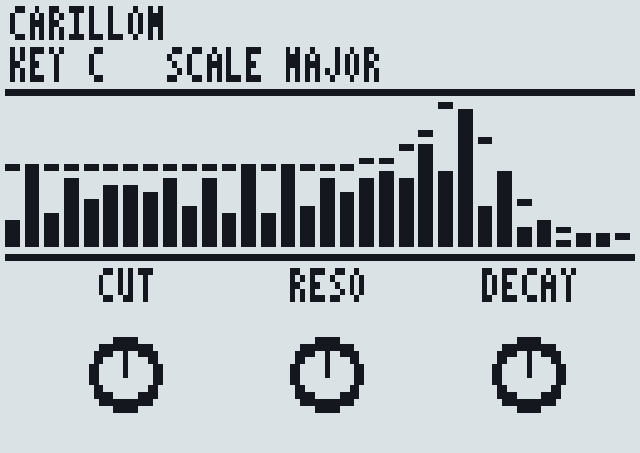
On firmware 2.10 the screen shows a bar per band (its level as it rings) and a mark per band at the filter’s shape (Cutoff, Reso, Slope and Waves together), with the Key and Scale in the header. A band snapped onto its neighbour’s note shows as a dot. On other firmware the still cover stays and the audio works the same.
How it works
Each band is a Chamberlin state-variable filter, which stays in tune down to C2, where a biquad’s coefficients run out of float precision. Decay sets each band’s width (Q 3 to about 3000) and caps its ring at 0.15 to 10 s. The coefficients are refreshed a quarter of the bank at a time, every 8 samples.
Building
python3 src/custom/carillon/build.py
Writes dist/Carillon.ZDL and its Effect Manager thumbnail. host.c runs the
same DSP on a computer (WAV in, WAV out, optional screen frames, one knob
turned mid-run); see its header.